What does this knob do? Building your own sound
Almost every synth has three stations: something vibrates, something shapes, something makes it loud and quiet. Most knobs belong to one of them.
Slowly close the filter above and open it again. That is the wah effect from a thousand tracks.
CH 13What a synthesizer is›A synthesizer produces sound instead of playing it back.1 min
A synthesizer produces sound instead of playing it back. It has no recordings in its belly but assembles the vibration itself from the ground up. That is why it can make sounds that do not exist in nature.
IN THE BOOKLET: CH 13 · OLD VERSION
CH 13A synthesizer is not a particular shape›That is the most common misconception.1 min
That is the most common misconception. „Synthesizer“ says nothing about the housing, only about the way the sound comes into being. The same technology sits in a wardrobe-sized cable monster and in a small box without a single key.
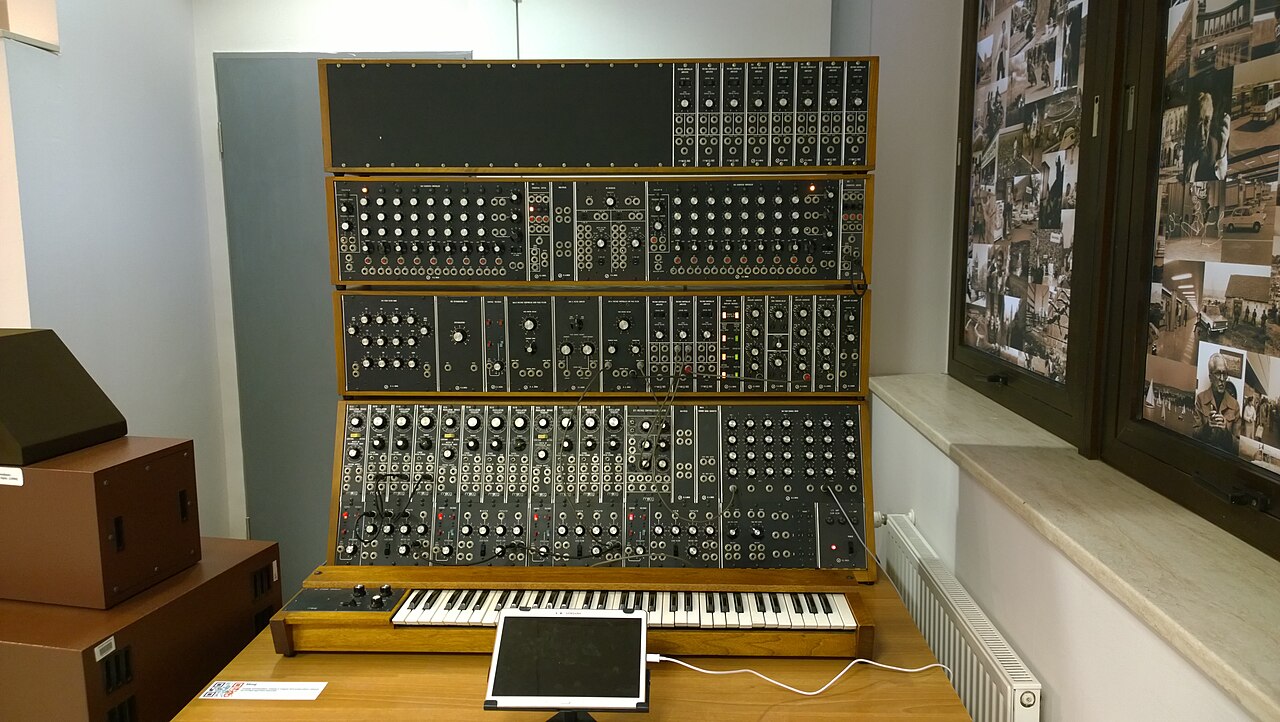
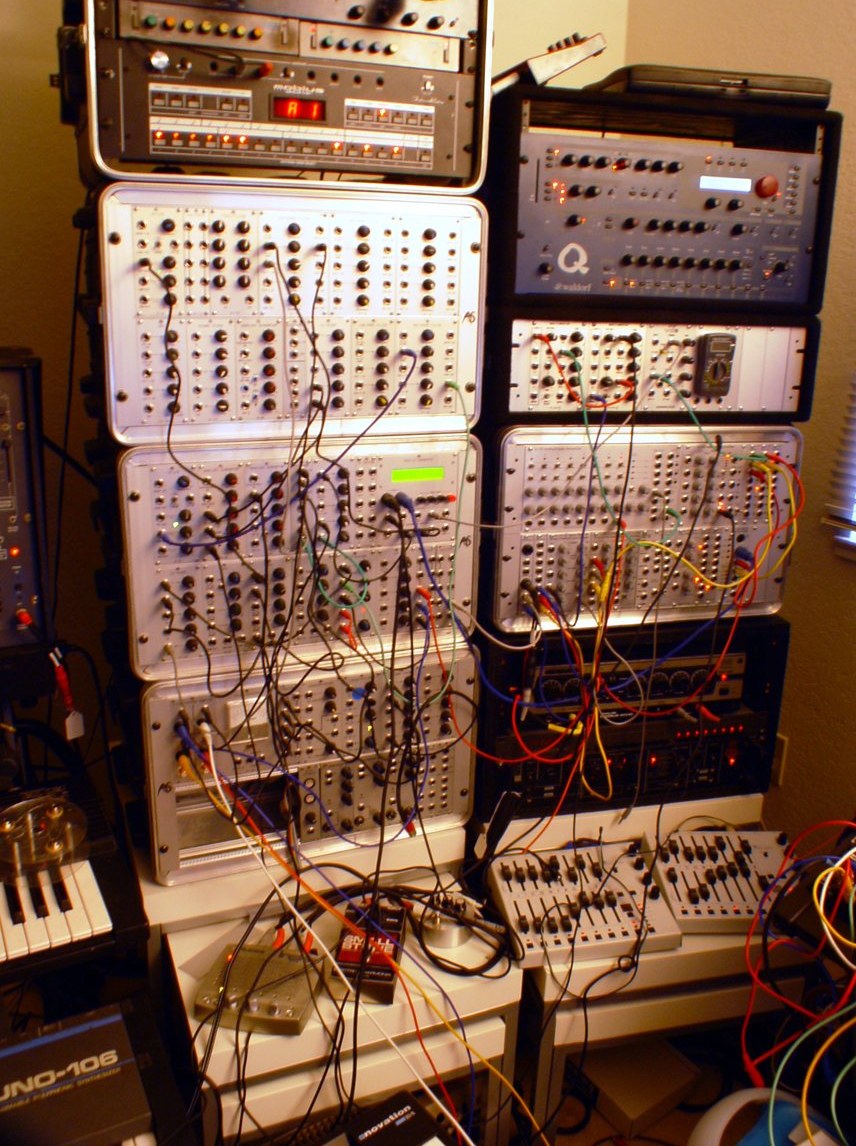
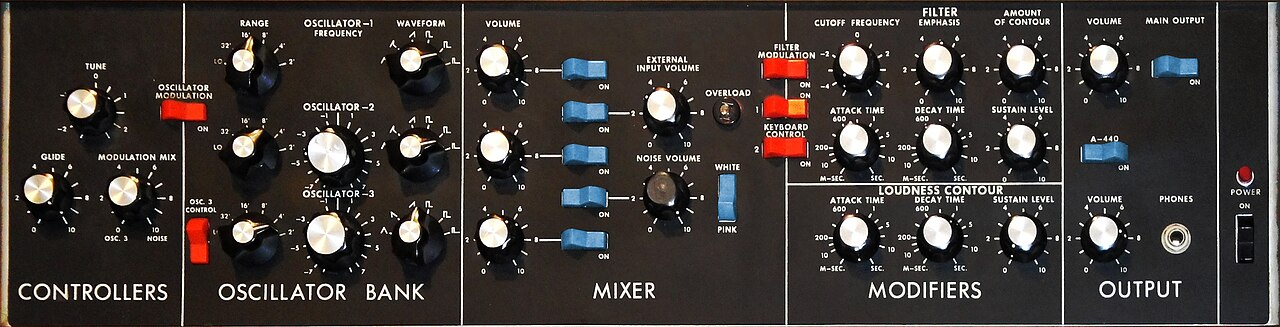
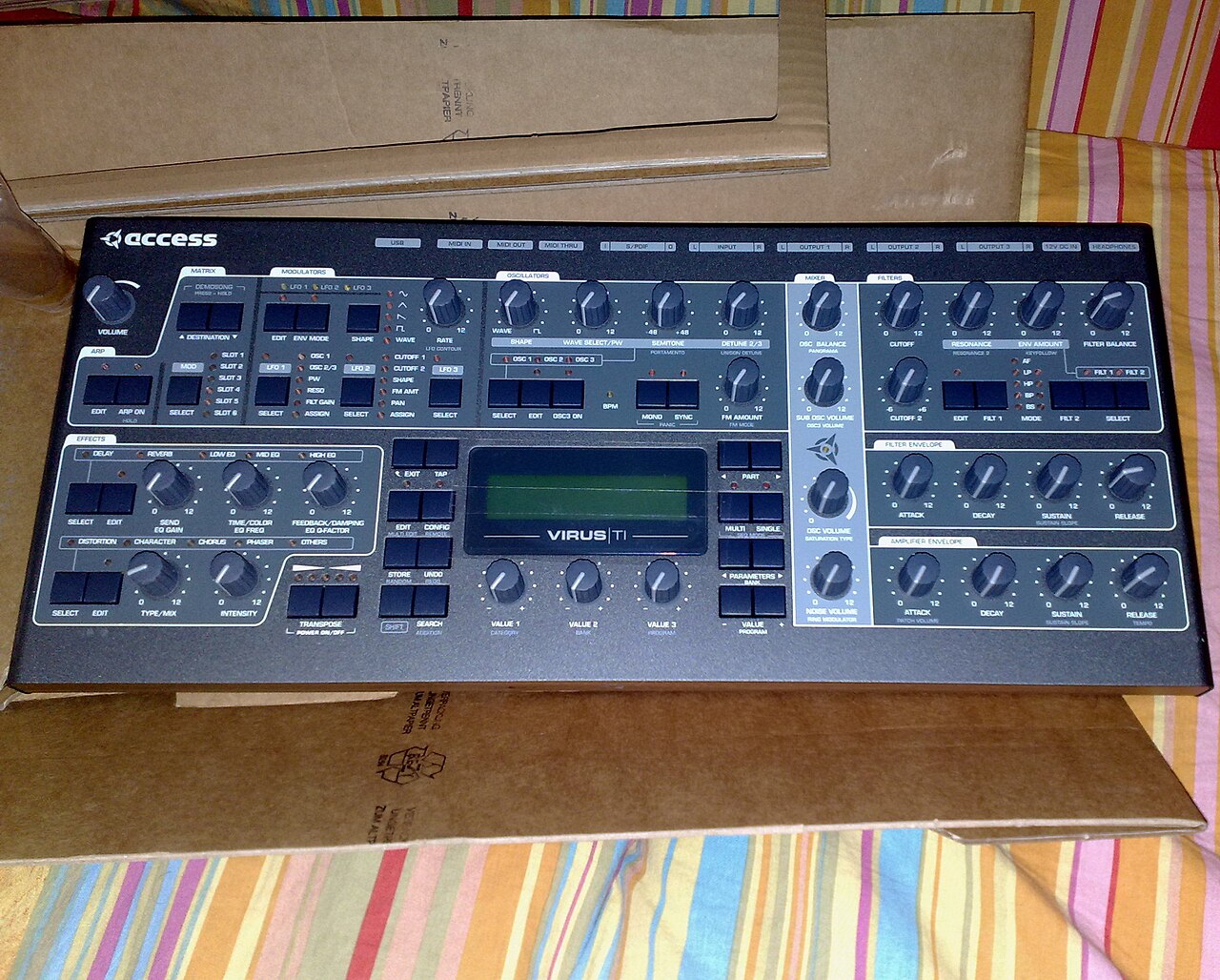
All four are synthesizers. A keyboard and a synthesizer are not the same thing. The keyboard is only the input, so the MIDI side. You can have a synthesizer with no keys, played by a sequencer. And you can have a keyboard that only plays back recordings and synthesizes nothing at all.
IN THE BOOKLET: CH 13 · OLD VERSION
CH 13The three stations almost every synth has›Every sound can be built from pure sine tones: the lowest one, the fundamental , sets the pitch, the harmonics above it set the timbre , that is whether something sounds sharp, hollow or round.6 min
The numbers
Height in decibels (dB): one line lower means a tenth as strong. The row of numbers underneath is the strength ratio of the fundamental and the 2nd, 3rd and 4th bar: in a sawtooth the second bar has half the strength of the fundamental, the third a third. Square and triangle only have the odd ones (1, 3, 5, 7); in a triangle they fall off with the square (1/9, 1/25), which is why it sounds so soft. The square is exactly half up, half down (duty cycle 1 : 1). Make the pulse narrower, say 1 : 3, and even overtones join in and it sounds thinner.Every sound can be built from pure sine tones: the lowest one, the fundamental, sets the pitch, the harmonics above it set the timbre, that is whether something sounds sharp, hollow or round.
- Oscillator. Produces a raw basic tone. Usually a simple waveform. A sawtooth sounds sharp and rich in overtones, a sine wave soft and round like a whistle.
- Filter. Takes parts back out of that sound. A low-pass lets the lows through and cuts the highs. This is the knob you hear most clearly in electronic music, when a sound slowly opens or closes. Right next to it almost always sits resonance: it lifts exactly the frequency the filter is currently cutting at. A little makes the sound more whistling and present, a lot is what turns a filter sweep into the effect you know from acid and techno. Turned all the way up, the filter starts to whistle by itself.
- Envelope and amplifier. Determine the shape over time. On the device there are four letters for this, A D S R, and you will find them everywhere: Attack, how quickly the note is there. Decay, how quickly it falls from its peak. Sustain, at which level it stays while the key is held down. Release, how long it rings on after you let go. An organ holds the note as long as the key is down. A piano starts falling immediately after the strike, even if you hold. Strings need a moment before the note is there. With the same four knobs you can get close to all three.
What a filter takes away shows up in the spectrum: the sound split into sine tones, each drawn as a bar at its frequency. A sawtooth at 110 Hertz, that is 110 oscillations per second, has its harmonics at 220, 330, 440 hertz and so on. It is measured in decibels, dB for short: minus 6 dB means half as strong, minus 12 dB a quarter.
[The hands-on graphic for this is above.]
Besides the cutoff, what matters is the slope: how much the filter takes away above the edge for each octave (each doubling of the frequency). 12 and 24 dB are common, also called 2-pole and 4-pole. A 24 dB filter sounds more decisive because one octave above the edge only a sixteenth is left instead of a quarter: as you turn the knob, you hear exactly where the edge is. There are three other basic shapes as well.
On top of that there is almost always an LFO, a very slow oscillation that does not sound itself but moves something else. Put it on the pitch and you get vibrato. Put it on the filter and you get the typical wobble.
IN THE BOOKLET: CH 13 · OLD VERSION
CH 13Several voices stacked: Unison›Many synthesizers can stack one voice several times.1 min
Many synthesizers can stack one voice several times. This is called Unison: several copies of the same voice, each slightly out of tune, which is called detune, and spread across the stereo image, that is, a little further left or right. This makes the sound wider and thicker. Many detuned sawtooth waves stacked together are the typical sound of trance, known as the supersaw.
The smallest example already shows what happens: two sawtooth waves at 110 and 111 Hz, that is 110 and 111 oscillations per second. Sometimes they run in step and reinforce each other, sometimes against each other and weaken each other. This swelling and fading is called beating, and it happens exactly as many times per second as the two are apart, so here once. With more voices, many such beats overlap.
IN THE BOOKLET: CH 13 · OLD VERSION
CH 13Different ways of building sound›Not every synthesizer works the same way.3 min
Not every synthesizer works the same way. You will meet the terms everywhere, so here are the five most important, each led by one sentence:
- Subtractive. Start with a sound rich in overtones and cut away what you do not want. The classic route, and the one the three stations above describe.
- FM. Two oscillations modulate each other. Gives glassy, metallic and bell-like sounds that are hard to get subtractively.
In detail: how FM works
To be precise, the modulator pushes the pitch of the carrier, the oscillation you actually hear, up and down, in the figure a hundred times per second. At that speed you no longer hear a wobble, you hear new overtones. How hard it pushes is called the modulation index or β for short. On a device the control may say Amount or Index, for example. The higher it is set, the more overtones. If carrier and modulator are in an uneven ratio to each other, the result sounds metallic and bell-like.
- Wavetable. Instead of one fixed waveform there is a whole table of them, and you travel through the sound from one to the next. Good for movement and development.
- Physical modelling. The computer simulates a real instrument including its material and breath noise, instead of recording it.
- Granular. A recording is cut into tiny pieces, the grains. Each one gets a short fade-in and fade-out, then a great many of them play at once, overlapping and in a new order.
In short: small grains turn the recording into a texture, large ones keep it recognisable in snippets.
In detail: grain size, position, density
The most important control is the grain size, meaning how long each grain is. The usual range is 1 to 100 milliseconds. Small grains dissolve the recording into a texture where no single detail can be picked out any more. With large grains it stays recognisable in snippets.
On top of that come the position, the point in the recording the grains come from, the density, that is, how many grains start per second, and the pitch of each grain. If the position stays put, all grains come from the same moment and the sound holds still. This is called freezing. If it moves through the recording more slowly than normal, the sound gets longer but not lower. This is called stretching.
IN THE BOOKLET: CH 13 · OLD VERSION
CH 26Tuning: how a beat becomes a note›Rhythm and pitch are the same thing, just at different speeds.6 min
Rhythm and pitch are the same thing, just at different speeds. Once you have heard it, you understand why chords sound the way they do, why every note has a colour, and why your synth needs a fine-tuning knob.
From beat to note
Play a kick twice per second and you count along. Ten times per second and it becomes a roll. From about 20 hits per second your ear stops counting and hears a pitch. The hits per second are then called Hertz (Hz). 110 hits per second are an A, 220 the A one octave above: twice as fast means one octave higher.
Two drums become an interval
When two drums play together, one hitting three times while the other hits twice, you hear a 3 : 2 polyrhythm. Speed both up by the same amount and it turns into a perfect fifth. Three drums in the ratio 4 : 5 : 6 become a major chord. The same numbers that run as a groove when slow sound as harmony when fast. In the web version of this booklet you can hear it above and switch between them.
Every note contains a chord
A played or sung note is never just one frequency. Above the fundamental, overtones vibrate at two, three, four times the frequency and so on (Booklet 1, chapter 13, adding sine tones). Heard one by one they are clear notes: octave, fifth, octave again, major third. Overtones 4, 5 and 6 are exactly the major chord from the drum experiment. Only together, and when they move together, does your ear hear a single sound with a colour.
Try it yourself: seeing overtones on the Mac
I show this on the synth, not in a video. On the Mac two free programs run next to the synth: Signalizer (open source, as a plugin and as a standalone app) shows the spectrogram, the overtones as lines on a time axis scrolling to the left, plus the spectrum as peaks and an oscilloscope. sMexoscope (GPL) is a plain oscilloscope, easy to read from afar, for the standing wave. You can install both yourself and put them after any synth in your app or DAW.
Your piano is a little out of tune. Why?
Pure intervals from the overtone series do not fit neatly into twelve equal semitones. Equal temperament, used by almost every keyboard, groovebox and DAW, splits the octave into twelve equal steps of 100 cents. In return every interval except the octave is shifted a little. The fifth only by 2 cents, the major third by 14 cents upwards. You can hear this as beating (Booklet 1, chapter 13): overtones of the two notes almost, but not exactly, line up, and the sound swells up and down.
Why exactly twelve?
If just intonation sounds nicer, why not tune everything that way? Because music changes key. Tune a keyboard justly in C and C major sounds perfect. Play D minor on it, though, and its fifth D-A is only 680 instead of 702 cents. The chord audibly howls. Listen to the chord progression below in both tunings.
The solution is to split the octave into equal steps. Then every key sounds equally good, none perfectly pure. Which leaves the question: how many steps? The graphic shows divisions from 5 to 19, plus the root's overtones as dashed lines, the spots where it sounds pure. With 12 steps the fifth and fourth are only 2 cents off the pure ones, the thirds 14 to 16 cents. No smaller division comes close, and many more keys per octave would be hard to play. Divisions like 19 or 31 even hit the thirds better; they are used in microtonal music.
Almost every synth has two tuning controls: Tune in semitones and Fine in cents. If two devices sound out of tune together, it is usually Fine or the reference tuning (often called Master Tune, standard 440 Hz for A). Detune between two oscillators, on the other hand, is on purpose: the beating makes the sound wide. Some synths and apps can also load completely different tunings, which is called microtuning.
Sources
Inspired by three Instagram reels from my collection; the graphics and sound here are my own versions: @thel.ab67, "When does a beat become a note?", @benfilippone, overtones become a voice, @zacbradfordvoice, overtones of the voice. On why twelve: Piano Mario, "Why are there 12 different notes?" (from 12:11).
IN THE BOOKLET: CH 26 · OLD VERSION
CH 20Eurorack, the construction kit›Eurorack is a construction-kit standard for hardware.2 min
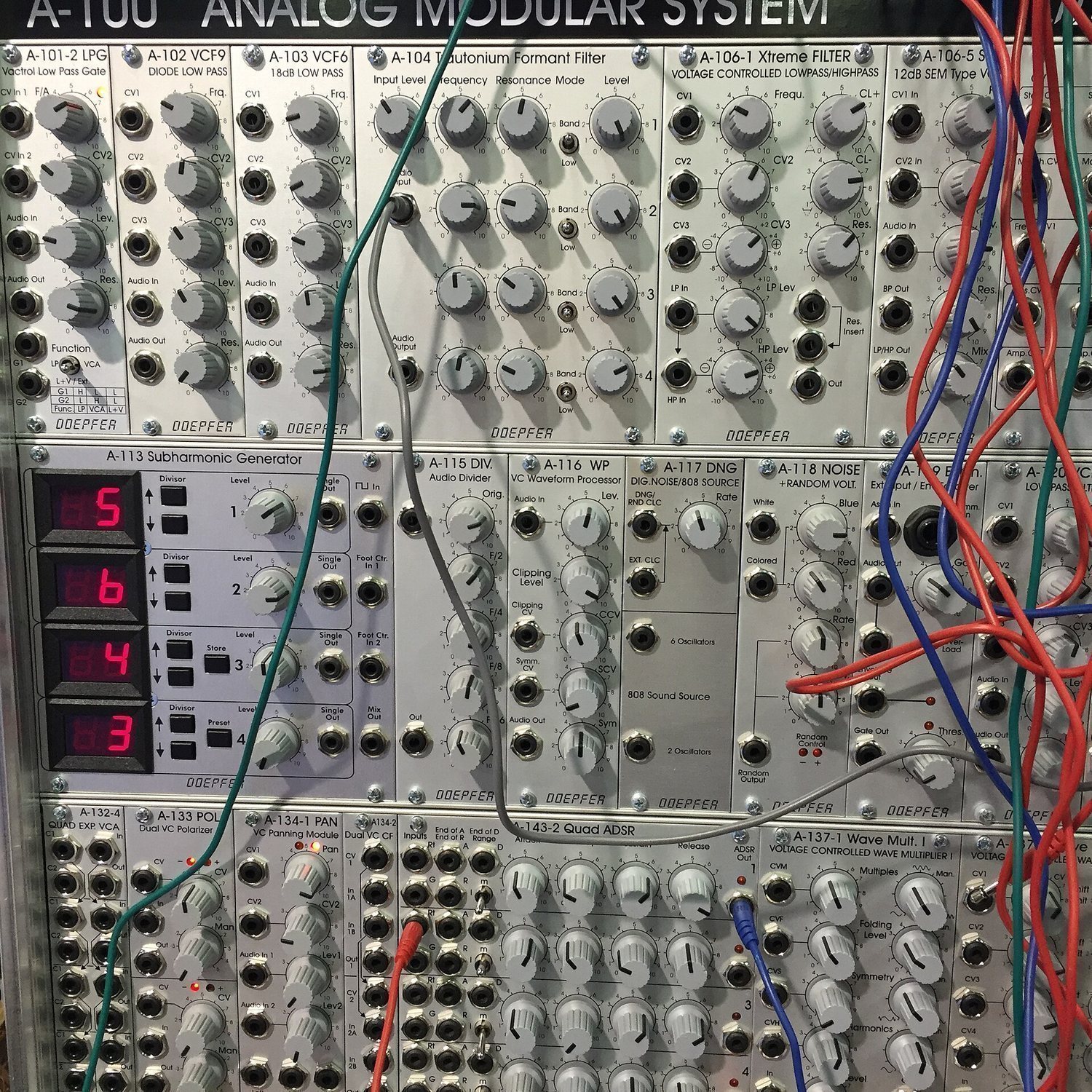
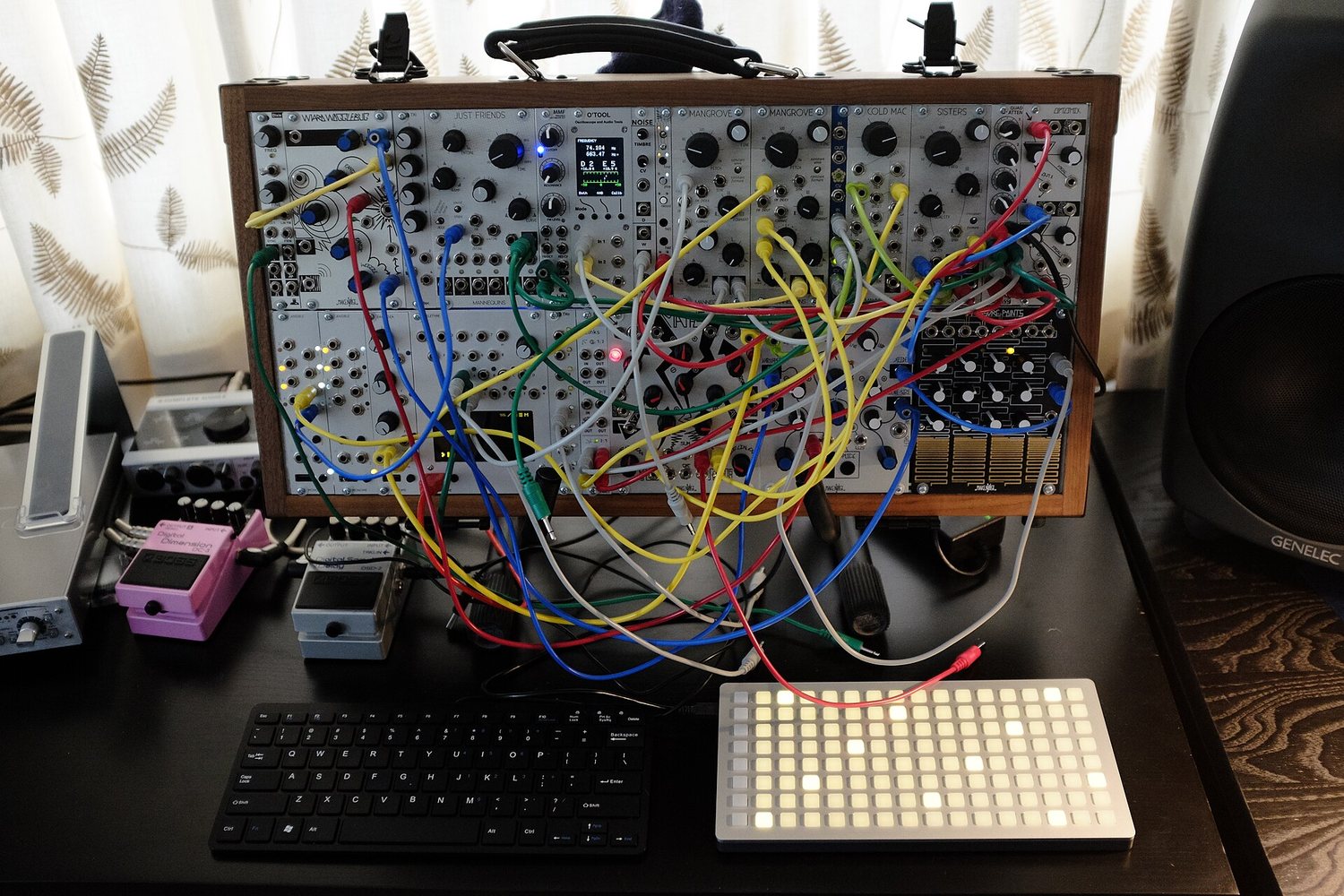
Eurorack is a construction-kit standard for hardware. Instead of a finished synthesizer you buy individual building blocks: an oscillator, a filter, an envelope, a sequencer, each as its own module. You cable them up yourself and thereby decide what your instrument even is.
It is exactly the chain from Booklet 1, only taken apart: the stations become individual devices you can plug together as you like. The price is that nothing is preconfigured and you have to make every decision yourself. For starting out it is the wrong route, for later one of the most interesting.
The modules do not talk via MIDI but via CV, control voltage: a cable carries a voltage, and that voltage tells the next module how high, how loud or how open. Clock there is simply a short voltage pulse per step. That is the CV route from Booklet 1, chapter 04.
Two addresses are enough to play the whole thing through on a computer. VCV Rack is a free modular system in software, with real modules recreated in it. At ModularGrid you assemble a case and see immediately what it costs and whether it fits. Both are the cheapest way to find out whether this interests you at all.
IN THE BOOKLET: CH 20 · OLD VERSION